
Ever wonder if a single tool can truly bring every dull pair back to life, or is that just clever marketing? The truth hinges on matching the sharpener to the blade’s edge and your own grip. Stick around, because the right pick changes everything, from fabric shears to kitchen workhorses.
Smith’s JIFF-S 10-Sec Knife & Scissors Sharpener
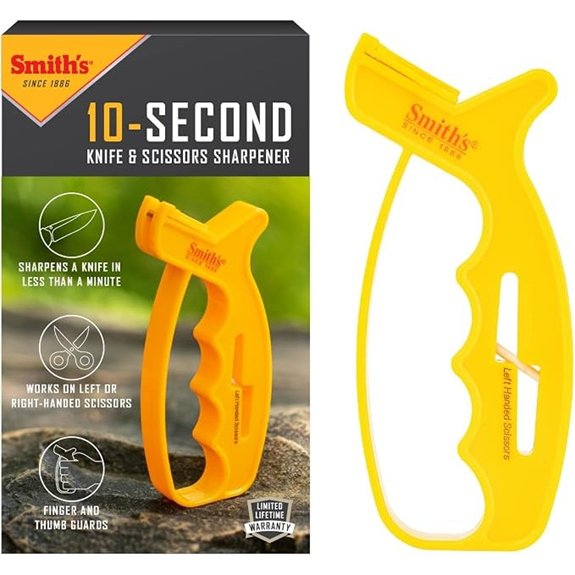
If you’re someone who needs a blade ready in seconds rather than minutes, the Smith’s JIFF-S 10-Sec Knife & Scissors Sharpener is your best bet. You just pull it through the V-shaped slot, and those crossed carbide blades do the heavy lifting. Three or four strokes, and you’re done. No guesswork, no angle math.
- Works on straight-edge knives, pocket, hunting, fishing, and kitchen blades.
- The patented scissors sharpener hides right in the handle, using a floating ceramic rod that adjusts to your exact blade angle, left or right handed.
- Full finger and thumb guards keep you safe while you work.
It’s only 2.4 ounces and 6 inches long, so you’ll toss it in a pack without thinking twice. The carbide blades are reversible and replaceable, giving you extended life from one tool. Quick, safe, and reliable, this is a no fuss sharpener that begs to be used.
Fiskars Universal Scissor Sharpener
https://m.media-amazon.com/images/I/41HQaKejiiL._AC_SX679_.jpg
You won’t find a simpler scissors sharpener. Grab your dull blades, left or right handed, and run them through Fiskars’ ceramic grinding heads. The sharpener automatically adjusts to your scissor’s edge, guiding each blade with just a cutting motion. It works beautifully on conventional and RazorEdge models.
But here’s the catch: skip this one for zigzag, curved tip, or serrated scissors. The plastic casing keeps things lightweight, weighing only 60 grams with a compact 4 x 9 x 13.8 cm footprint. The white and orange Finnish design feels solid in hand, plus it’s easy to clean hygienically. Simple, effective, and ambidextrous.
SHARPAL 191H Knife Scissors Sharpener
https://m.media-amazon.com/images/I/71mnv7pZfNL._AC_SX679_.jpg
The SHARPAL 191H is the best pick for home cooks who want one tool to handle both knives and scissors. You’ll simply press it onto a smooth counter, and that enhanced suction base locks it down. No more holding it steady with one hand while you work, which feels both safer and easier. It’s compact enough to tuck into a drawer, so you won’t sacrifice precious counter space.
This tool shines with its 3-stage system:
- Tungsten carbide blades quickly reset your edge
- Ceramic blades hone for that precise finish
- A dedicated tungsten carbide blade tackles your scissors specifically
It handles straight, serrated, and kitchen knives alike. And you can use it comfortably whether you’re right or left-handed. Fine grit means you’re not hacking away metal; you’re refining it. Plus, you’re covered with a 3-year warranty from Sharpal, so you can buy with confidence.
AccuSharp Hand-Held Carbide Knife & Scissor Sharpener
https://m.media-amazon.com/images/I/71Ai0ZQZgeL._AC_SX679_.jpg
Anyone wanting a fast, no-fuss way to restore knives and scissors will find the AccuSharp combo pack a perfect fit. You’ll achieve a razor edge in about 10 seconds, no sweat. It works on chef’s knives, serrated blades, fillet knives, and even cleavers. The ShearSharp handles general-purpose scissors, hedge clippers, and tin snips without complicating your life.
The secret? Diamond-honed tungsten carbide blades that are reversible, doubling their lifespan. Expect to replace them every 5 to 10 years. Ergonomic handles fit both hands, and a full finger guard protects you. Clean them with soap and water, or toss them in the dishwasher. It’s that simple.
Fiskars SewSharp Scissors Sharpener (98547097)
https://m.media-amazon.com/images/I/81vuFWyq8VL._AC_SX679_.jpg
For quick, reliable blade revival, this sharpener is your best bet if you’re a right-handed sewer, crafter, or quilter who needs a no-fuss fix. Its ceramic rods glide through a few passes to restore a clean edge, no oil or skill required. Just insert your scissors with slots facing up, apply gentle pressure, and pull through evenly. You’ll feel the difference immediately.
It’s tiny, about 1.9 inches long, so toss it in your sewing kit or purse and forget it’s there until you need it. Just remember, it won’t work on left-handed blades, pinking shears, or serrated edges. For straight, standard scissors, it’s a dependable, budget-friendly sharpener that lasts for years.
4-in-1 Knife Sharpener for Kitchen Knives & Scissors
https://m.media-amazon.com/images/I/71yXvtgA3rL._AC_SX679_.jpg
You’re hunting for one tool that handles every blade in your kitchen, and this 4-in-1 sharpener is your best bet. It’s a compact manual pull-through that tackles chef knives, cleavers, and scissors with a three-stage system: tungsten steel repairs nicks, grinding slot restores edges, and ceramic polishes them to a fine finish. A dedicated scissor slot adds versatility.
- Simple setup: Insert the blade, pull through, and you’re done. No skill required.
- Safe grip: Ergonomic handle and non-slip base keep control steady.
- Built to last: Reinforced ABS housing and high carbon steel components hold up through heavy use.
At 8 inches long and under 5 ounces, it stores easily. Coarse and fine grits mean you can fix dullness or refine sharpness. Rated 4.2 stars from 466 users, it’s a reliable kitchen workhorse. Grab one, and skip the professional sharpening bills.
Scissors Sharpener Tool
https://m.media-amazon.com/images/I/71CnjCOM2JL._AC_SX679_.jpg
Scissor sharpeners are a dime a dozen, but the Orange Ninja Scissors Sharpener Tool stands out if you own a mix of household, office, sewing, or culinary shears. It’s built for straight blades only, so skip it for knives, ceramic edges, or pinking shears. You’ll appreciate the four angle presets: 40°, 45°, 55°, and 60°, which handle everything from fine fabric to tough kitchen work. The enclosed slot stabilizes each blade, so you can push through with controlled, single-handed strokes. Heavy-duty tungsten carbides and diamond plates do the grinding, and the ergonomic body keeps it comfortable. At 7 inches long and 8 ounces, it’s compact but sturdy. Just match the angle to your blade type, run a few passes, and you’re done. It’s a reliable, no-fuss sharpener for regular use.
Longzon 5-in-1 Knife Sharpener with Cut-Resistant Glove
https://m.media-amazon.com/images/I/71Iw87jBnnL._AC_SX679_.jpg
The Longzon 5-in-1 Knife Sharpener is the best pick for home cooks who want restaurant-level edges without the learning curve of whetstones. You get four precision stages: a scissors slot first, then coarse grinding to repair damage, fine grinding to hone, and a precision slot for that final polish. It works on stainless steel, pocket knives, and more. A non-slip base keeps it stable, and you even get a cut-resistant glove included. No special skills needed, just pull your blade through. Prep time shrinks, your knives last longer. Perfect for busy cooks who value safety and simplicity.
SHARPAL 201H Scissor Sharpener – Adjustable 22°-84° Angle
https://m.media-amazon.com/images/I/614UYC2ugmL._AC_SX679_.jpg
For anyone needing one sharpener for both fine kitchen shears and heavy garden pruners, the SHARPAL 201H is your best bet. You’ll dial in the exact angle using the dual A and B scales, covering everything from 22° to 84°. That’s precision for delicate hair shears or beefy mower blades, and the floating clamps grip curved edges securely, so you won’t fight for control.
You get two replaceable diamond plates: 325 grit for repairing nicks, then 600 grit for refining the edge. The triangular design reaches deep into narrow openings, so you can sharpen base to tip without taking anything apart. Plus, protective tip caps keep your fingers safe, and the whole unit measures about 6.2 inches long, weighing under a kilo. That’s durability with a 3-year warranty backing it.
Orange Ninja Scissors Sharpener Tool – 4 Angle Settings, Easy Manual Use
https://m.media-amazon.com/images/I/71nhfBSdjxL._AC_SX679_.jpg
You need a sharpener that handles multiple scissor types without guesswork. The Orange Ninja delivers with four precision angles you adjust via a simple dial. It’s built for kitchen shears, fabric scissors, sewing snips, craft cutters, and straight hair scissors. You just slide the blade into the safe slot-guide, which keeps your fingers out of harm’s way. Industrial strength tungsten sharpeners restore edges for clean cuts on paper, fabric, or herbs. And at only 8 ounces, you’ll find it easy to control with one hand. It’s a quick touch up tool, not a heavy duty solution. But it’s perfect for household and workshop use.
Factors to Consider When Choosing Scissor Sharpeners
You’ll want to check if the sharpener’s abrasive material matches your scissor’s blade type, since hard steel and softer alloys need different treatments. Precision in sharpening angles matters too, because even a few degrees off can ruin your cut’s edge. And don’t overlook safety guards and durable components, since these determine both how easy and how long your tool will last.
Blade Material Compatibility
Why does blade material matter so much? Because using the wrong sharpener on your scissors is like using a butter knife on a steak; it just won’t cut it. You’ve got stainless steel, carbon steel, or ceramic blades, each demanding specific treatment. Some sharpeners are built for traditional carbon steel and will utterly fail on ceramic or coated edges; that’s a quick way to damage your investment.
Sharpening Angle Precision
Since the sharpening angle fundamentally dictates how your scissors will cut, getting it right matters more than you might think. This angle, typically ranging from 22° to 84°, reforms the blade’s edge and directly impacts performance and safety. A precise angle restore restores factory specs, ensuring clean cuts without stripping fabric. But an off angle can overgrind the blade, weakening it and shortening its lifespan.
You’ll want a sharpener with adjustable angle settings. This flexibility lets you tailor the edge to your scissors, whether you’re sharpening delicate embroidery shears or heavy duty kitchen shears. For example:
- Delicate scissors need a sharper angle (around 22° 30°) for precision.
- Heavy duty blades benefit from a wider angle (closer to 84°) for durability.
Choose a model that locks into your chosen angle. Consistent results mean your blades stay sharp longer, without the risk of damaging them.
Safety Guard Features
How do you keep your fingers safe while sharpening those dangerously sharp blades? You don’t gamble with your digits, that’s for sure. Look for full-length finger and thumb guards, those plastic or metal shields that sit between you and the cutting edge. They’re not just padding; they force your hand into a stable, correct grip, which cuts down on slips entirely. Blade slots, where the scissor slides in, also add a layer of protection by keeping the edge buried until it hits the stone. Finger shields on the base? Yes, please, especially if you’re a beginner. They let you focus on the angle, not the fear. And that confidence matters, because a steady hand produces a cleaner edge. Honestly, a guard that covers the tip is a small feature with a huge payoff. You’ll sharpen with peace of mind, not white knuckles.
Ease of Use
Three key factors make a scissor sharpener easy to use, so you can get back to cutting without wrestling with the tool. First, look for clear, step-by-step instructions; you shouldn’t need a manual to decipher a manual. Second, ergonomic handles or soft grips keep your hand comfortable, even if you’re sharpening a dozen pairs in one sitting. Third, safety features like finger guards or enclosed slots let you operate with confidence, not caution.
You’ll also want a process that’s a simple pull or slide motion, no clamping or angle math required. And pick a model known for quiet operation; a loud, grinding tool just adds stress. Stick with these basics, and you’ll find sharpening becomes a five-minute chore, not a project.
Durability of Components
When you’re sizing up a scissor sharpener, the durability of its components is what separates a tool that lasts from one that quits on you after a few uses. You want components made from high-quality materials like tungsten carbide, diamond, or ceramic. They resist wear far longer than cheaper alternatives. Look for reversible or replaceable blades too. That way, when one edge dulls, you just flip or swap it instead of tossing the whole sharpener. Construction matters: sturdy plastics or metals prevent cracking, while reinforced or thick abrasive plates won’t chip under pressure. Durable components mean you won’t need repairs or replacements anytime soon. That’s cost-effectiveness in action. So, invest in a sharpener built to endure. It’ll reward you with consistent performance for years.
Portability and Size
Since portability often determines whether you’ll actually use your sharpener when you need it, size and weight become key factors. You’ll want a compact model, typically under 8 inches, that slips easily into a sewing kit, toolbox, or even your pocket for on-the-go touch-ups.
- Weight matters: Lightweight designs won’t weigh down your bag, but they can feel less stable during use.
- Ergonomics are a bonus: Portable sharpeners often include contoured handles or shapes that make one-handed sharpening comfortable, even in tight spaces.
But don’t ignore stability. Heavier, larger models give you more control and a firmer grip, ideal for precision work at home. So ask yourself: do you need a travel companion or a workshop staple? Your answer determines the right size for your scissors.
Versatility for Scissors
Once you’ve settled the portability question, the next factor that really separates a one-trick gadget from a keeper is versatility. A truly versatile scissor sharpener works with household, sewing, kitchen, and even heavy-duty shears without skipping a beat. It should offer multiple sharpening slots or adjustable angle settings to handle different blade bevels and edge conditions.
You’ll want one that accommodates various blade thicknesses without damaging your tools. And don’t forget compatibility with both right- and left-handed scissors, since a sharpener that only works one way limits you. Look for features like different abrasive materials, which let you switch from a coarse grind to a fine polish depending on the blade. For example, a tungsten carbide slot for quick repairs and a ceramic rod for honing gives you serious range. That kind of flexibility makes a sharpener a keeper, not a one-job wonder.
