Choosing the right knife can feel like a balancing act between durability and precision.
If you want a tough, versatile blade for heavy-duty tasks, a German knife might be your best bet.
But if you prefer razor-sharp slices for delicate work, a Japanese knife could be the way to go.
The key difference lies in steel hardness and blade design, affecting how each performs in the kitchen.
Keep reading to find out which style suits your cooking style best.
German vs. Japanese Knives: The 3 Core Differences
German and Japanese knives differ primarily in three core aspects—steel composition, blade shape, and weight balance. German knives typically use softer stainless steels like X50CrMoV15, which emphasize toughness and resistance to rust. These blades are generally thicker with more robust spines, making them durable and less prone to chipping, but they may require more force to cut and need frequent sharpening for a sharp edge. Just as a quality charcuterie board relies on durable materials for long-term use, top charcuterie boards balance style and performance to help buyers choose.
Japanese knives, on the other hand, employ harder steels such as VG-10 or SG2. These steels support finer, sharper edges and better edge retention, but the blades are usually thinner and more tapered. The reduced thickness minimizes resistance during cutting, allowing for precise, controlled slices. Their sharper profile is ideal for delicate tasks that demand accuracy. For those seeking a comprehensive collection, a knife set with block offers both quality and performance to suit various cutting styles.
Blade shape also distinguishes these two styles. German knives tend to have more curved profiles, facilitating a rocking motion suited for chopping. Japanese knives are typically straighter or more subtly curved, optimized for push cuts and vertical slicing that demand clean, controlled movements.
Finally, weight and balance reflect cultural design philosophies. German knives are heavier and have a blade-forward feel, providing more power for heavy-duty tasks. Japanese knives are lighter and more nimble, reducing fatigue during detailed, precise work. Your choice hinges on whether you prefer a versatile, sturdy knife or a tool designed for finesse. When selecting a set, it is helpful to consult a review of the best cutlery sets for additional perspective on overall quality and value.

【Premium Damascus Chef Knife with VG-10 Steel Core】Our Japanese knives feature a VG-10 steel core (62 HRC) for unmatched sharpness and stain resistance. The 67-layer Damascus cladding ensures durability while adding elegant, rust-proof patterns—perfect for both professional kitchens and home use

JAPANESE CHEF KNIFE: The Shun Classic 10-inch Chef's Knife is expertly designed for a variety of kitchen tasks, from slicing and dicing to mincing, making it an indispensable tool for any cook.
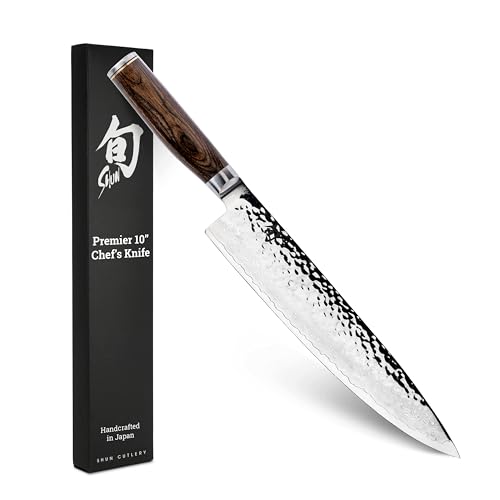
JAPANESE CHEF KNIFE: The Shun Premier 10-inch Chef's Knife is expertly designed for a variety of kitchen tasks, from slicing and dicing to mincing, making it an indispensable tool for any cook.
How Hardness and Edge Angle Affect Your Cutting
A softer German steel with a hardness of 54 to 58 HRC pairs best with a wider edge angle of 17 to 20 degrees per side. This combination sacrifices some initial sharpness for increased durability, as the edge is less likely to chip and more resistant to rolling under stress. While the blade may offer higher cutting resistance, it provides a tougher, more forgiving edge that requires less maintenance. To refine such edges, many turn to Japanese sharpening stones for their ability to produce precise, consistent results on high-carbon steels. For example, using a dishwasher can expose wooden handles to excessive moisture and heat, which may cause warping or cracking over time. For field dressing tasks like skinning deer, a softer steel with a wide edge angle is often preferred for its resilience against bone contact.
Matching hardness to angle is crucial: a harder, sharper edge gives you more control and precision, ideal for detailed work, but it can be more delicate. Conversely, a softer steel with a wider angle delivers greater robustness, making the blade suitable for more heavy-duty tasks or industrial use. Your choice should depend on your specific cutting style and conditions.
Blade Thickness, Weight, and Feel in the Kitchen
Blade thickness and weight play crucial roles in how a knife feels in your hand. A Japanese gyuto with a thin blade around 1.5 to 2.4 mm will glide smoothly through produce with minimal friction, making precise cuts easier. In contrast, a German-style chef’s knife with a thicker spine near 3 to 5 mm provides a more wedge-like, robust cut, giving a feeling of added power. The weight of the knife further influences ergonomics. A lighter Japanese knife, typically weighing between 140 and 180 grams, feels nimble and can help reduce wrist fatigue during extended prep sessions. Conversely, a heavier German knife, around 200 to 260 grams, feels more planted in your hand and offers a sense of forcefulness, which can be advantageous for harder or denser ingredients. Blade flexibility also varies with thickness. Thinner Japanese blades tend to bend slightly, aiding delicate cuts and finesse work. Thicker German blades are usually rigid, providing stability for tougher tasks. Ultimately, the feel comes down to personal preference: you might favor the agile, precise glide of a thin blade or prefer the grounded, substantial feel of a heavier one. To preserve the sharpness of either blade, always use a cutting board made of wood rather than harder materials, and applying pure tung oil to the board helps protect it from moisture and cracking. For maintaining that edge, a ceramic sharpening stone offers an excellent balance of speed and control without the need for oil.
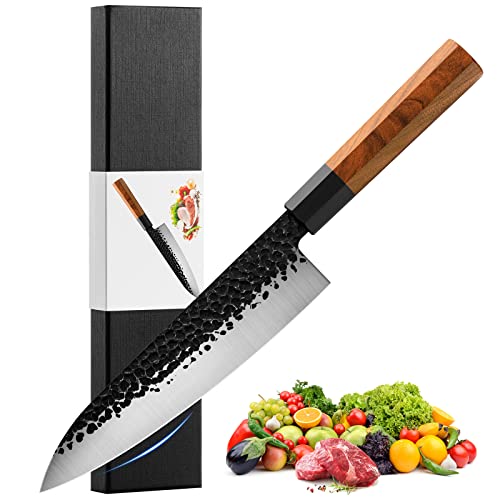
【Classic Japanese Chef Knife】 - Professional Japanese chef's knife has a unique & beautiful hammered pattern and high carbon AUS-8 stainless steel blade. Through the knifemaker's manual fine knife shape and pounding out the gorgeous pounding texture, into the perfect forging art and craftsmanship

67 Layers Damascus Steel: Every blade of this damascus chef knife is made of 67 layers damascus steel with VG-10 core, known for its exceptional hardness (HRC 60-62), ultimate edge retention, and corrosion resistance. The Damascus steel wavy pattern isn’t just stunning—it enhances strength, flexibility, and resistance to chipping

[9-Layer Forged Structure] This professional chef knife is meticulously crafted with a 9-layer forged steel construction, delivering superior durability, corrosion resistance, and chip prevention. The multi-layer forging design not only reinforces blade strength but also enhances cutting stability, making this gyuto knife an essential tool for both professional chefs and home kitchens
Does Your Cooking Style Favor Rocking or Slicing?
Your cutting motion should guide your choice of knife. If you favor a rocking motion, a German knife with its curved blade and heavier weight is ideal. This technique involves anchoring the tip while the handle rises and falls in a steady arc, allowing for a fast rhythm that’s perfect for mincing herbs, garlic, and onions. The knife’s curved profile supports this motion, and the weight helps drive through ingredients with minimal effort. The balance of a German knife shifts toward your hand during each rock, making the process more efficient. For those seeking the best value in German-style designs, quality utility knives offer comparable performance at a lower price point.
On the other hand, if your preferred technique is slicing, a Japanese knife with a flatter profile and lighter feel works best. With a slicing motion, you use a forward or pull cut, reducing vertical pressure and producing thin, even slices. This approach is well-suited for proteins, fruits, and layered vegetables, where precision and clean cuts matter. Japanese knives excel here because their design allows you to maintain a smooth rhythm and a more balanced control during slicing. Your ingredient shape ultimately determines which motion fits best—irregular or lumpy items are easier to rock through, while large, flat foods benefit from a slicing approach. Match your knife to yourPrep style for optimal results.

Fast Chopping Knife with Rocking Motion: Curved blade design allows natural rocking motion for quick chopping, slicing, and dicing vegetables, herbs, and meats—ideal for meal prep and everyday cooking

Fast Chopping Knife with Rocking Motion: Curved blade design allows natural rocking motion for quick chopping, slicing, and dicing vegetables, herbs, and meats—ideal for meal prep and everyday cooking

Curved bolster encourages cutting with improved precision, safety and Comfort
Which Dulls Faster? The Real Maintenance Trade-Off
German knives dull faster but are easier to refresh, whereas Japanese knives stay sharper longer but require more skill and finer abrasives to sharpen. German blades, typically softer at 55–58 HRC, can lose their peak sharpness after 2 to 3 hours of use. This makes them suitable for quick, frequent honing with a honing rod to maintain their edge. In contrast, Japanese knives with a hardness of 60–65 HRC remain razor-sharp for 8 to 12 hours but demand delicate, skillful sharpening with whetstones. For those seeking a natural stone option, Arkansas stones offer a fine-grained abrasive that works well for maintaining both types of edges. The trade-off boils down to maintenance: German knives dull more quickly but are easier to revive, while Japanese blades stay sharper longer but require careful, meticulous sharpening practices. For those considering their next purchase, a detailed comparison of top picks on quality can further clarify which style best matches your workflow. Your choice depends on whether you prefer simple, fast touch-ups or infrequent, precise sharpening sessions. A quality belt knife sheath can also be a key factor when selecting a practical knife companion.
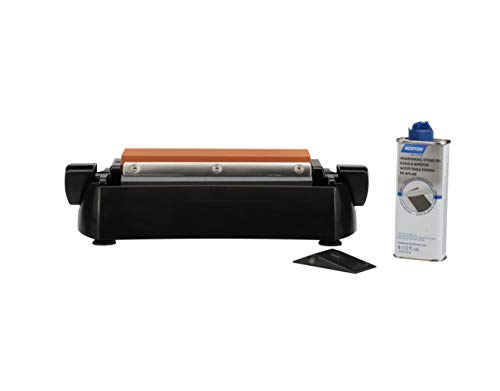
Protect your investment in quality knives with this IM200 Tool and Knife Sharpening Stone Set with 3 oil stones, including: 100 Grit Oil Stone made of Silicon Carbide for Repairing; 150 Grit Oil Stone made of Silicon Carbide for sharpening and maintaining edges and 320 Grit Oil Stone made of Aluminum Oxide for honing cutting edges
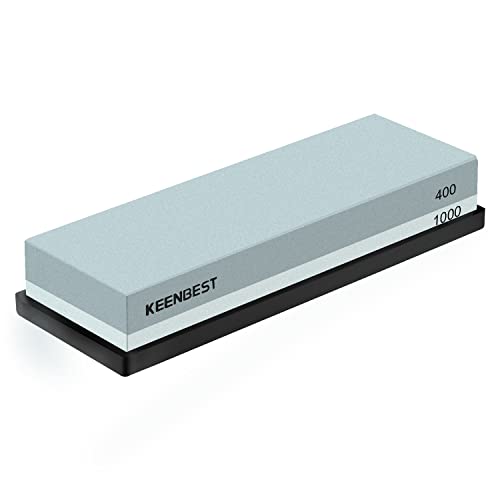
No oil needed, just put the stone into water for 10-15 minutes before using and they are ready to use. You can always adding water on it while sharpening, with water the lubricating effect of grinding will be great and helps you to save strength

【Complete Knife Sharpening Stone Kit】You don't need to be a Pro to sharpen your blades, all you need is the right tools & technique. All the sharpening tools you need are here, one affordable set for you: 400/1000 & 3000/8000 grit whetstone; Coarse flattening stone; Non-Slip Bamboo base; Knife sharpening angle guide; Leather strop, a simple instruction manual about how to use and what does every component do.
German vs. Japanese: Who Should Buy Each
Choose a German or Japanese knife based on your preferences for durability versus precision. A German knife is ideal if you want a versatile, sturdy tool that can handle a wide range of tasks. Its heavier weight and forgiving blade make it suitable for chopping herbs or cutting through dense ingredients like squash. It also tends to require less frequent sharpening and is easier to maintain, thanks to traditional full-tang construction from brands like Wüsthof or Henckels. German knives emphasize durability and practicality, making them perfect for everyday use at home. For those who also appreciate unique kitchen tools, wood cutting boards designed to resemble books offer a stylish and functional pairing with your knife choice. Many home cooks find that a German chef’s knife serves as the primary blade for most meal preparation. However, unlike a charcuterie board, which can be unhealthy due to high sodium and saturated fat, a German knife contributes only to efficient meal prep.
In contrast, a Japanese knife is best if you prioritize finesse and lightweight control. These knives feature a thinner, sharper edge that excels at push-cutting vegetables, fish, or boneless proteins for precise, clean slices. However, they are more delicate and can chip if handled improperly. Japanese craftsmanship from brands like Shun or Global focuses on refined cutting performance, suited for intricate tasks that demand accuracy. Choose a Japanese knife when you want a tool that delivers clean cuts and fine detail, understanding that it may require more careful handling and regular sharpening.

FOR DAILY HOME COOKING, BBQ PREP, AND THE WEEKEND COOK WHO'S IN THE KITCHEN FROM 8AM ON: The 8" Gladiator Elite is the Western-style workhorse — a little heavier, a little heftier, tuned for the rock-cut rhythm most home cooks and pitmasters grew up with. Onions, herbs, proteins, peppers, roasts — every night, every meal.

PROFESSIONAL KNIFE SETS FOR CHEFS: Elevate your culinary skills with this 3 piece knife set of 8" Chef, 7" Santoku and 5.5" Kitchen Utility Knives. Ideal for chefs and home cooks alike, it's a must-have for any kitchen.
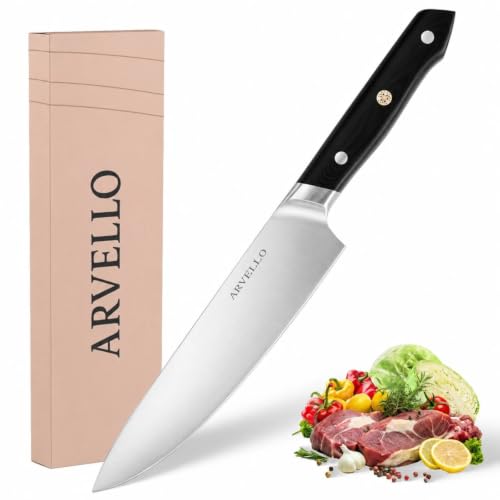
German High Carbon stainless Steel Blade: It is manufactured from premium 1.4116 German stainless steel, this is a non-corrosive and ultra-sharp knife with a reliable, heavy-duty performance that holds up to daily kitchen demands.