
Wondering if wood fiber cutting boards are safe to use? You might have seen claims about their eco-friendliness and durability, but safety isn’t always guaranteed.
While they’re made from compressed cellulose and food-grade resins, labels like BPA-free don’t always mean zero chemical leaching.
To get the full picture, it’s best to look for trustworthy certifications like the FDA or LFGB.
Keep reading to understand what really matters when choosing a safe cutting board.
What Exactly Are Wood Fiber Cutting Boards Made Of?
Wood fiber cutting boards are made from compressed cellulose-based fibers, such as pine wood shavings or recycled paper by-products. These fibers are combined into a dense, layered composite material. During manufacturing, high heat and pressure—around 140°C and 2800 tons—are applied to fuse the fibers together securely. A food-grade resin acts as a binder, holding the fibers in a stable structure and ensuring the board’s durability and uniformity. Unlike solid wood, this engineered material results in a smooth, resilient surface that resists splitting and warping over time. It’s important to note that these boards are manufactured composites, not single, untreated pieces of lumber. The design logic of such boards prioritizes cost-effective durability over natural aesthetics, contrasting with the premium materials and handcrafted appeal that drive up prices for charcuterie boards. For context, charcuterie boards often require a thickness of at least 1.5 to 2 inches to prevent cracking under heavy use, a standard not applicable to these thinner fiber composites. However, when selecting any cutting surface, overall knife performance depends heavily on the board’s hardness, as softer materials like these composites can dull blades faster than end-grain wood options found in premium sets.
Are Wood Fiber Boards Really BPA-Free and Food-Safe?
BPA-free labels on wood fiber cutting boards do not guarantee they are entirely food-safe. While these labels indicate the absence of bisphenol A, manufacturers often use alternative chemical binders, such as phenolic resins, which can include BPF—another bisphenol with similar safety concerns. Therefore, a board marked BPA-free may still leach other potentially harmful chemicals during use.
Material safety depends more on manufacturing standards than just labels. Look for boards that explicitly state compliance with FDA or LFGB standards and are backed by third-party testing. Without such proof, BPA-free claims can be just marketing tricks. These boards might avoid BPA but could still release other chemical additives when in contact with food.
To ensure safety, choose products that verify no BPA, BPF, or related bisphenols are used. Always check for documentation confirming rigorous food-contact testing. Relying solely on a BPA-free label might leave you exposed to unintended chemicals.

DISHWASHER SAFE FOR EASY CLEANUP: Non-porous composite material cleans quickly in the dishwasher for everyday kitchen convenience.

🌟 A Cut Above - 11.5 x 9.5 inch wood fiber composite cutting board, wooden natural color, removable silicone corners, dual-sided cutting surface. If you are looking for a sturdy cutting board that is extremely safe to use, then we got you covered. BPA-free, LFGB approved, dishwasher safe, TOPTIER eco cutting boards provide a hypoallergenic food prep surface for every meal.

Dishwasher Safe Wood Fiber Board: Made from compressed wood fiber composite with 80% pine wood fiber, this 15 x 11.25 inch kitchen cutting board goes straight in the dishwasher. It is a non-plastic choice for everyday chopping, slicing, and dicing.
How to Verify Safety Certifications on a Wood Fiber Board?
To verify a wood fiber board’s safety certifications, you must check the certification documentation directly. Locate a specific declaration of conformity for your exact board model. This document should specify an authoritative certifying agency such as NSF, FDA, LFGB, or EU 1935/2004. Avoid relying solely on vague claims like “food safe” without supporting documentation.
Next, ensure the document references recognized safety standards like NSF/ANSI 2 or EU 10/2011. Confirm that the certificate number listed is valid by searching the official registry of the certifying body. Badge images or stickers alone do not prove certification coverage; always verify the registration status, expiration date, and the product category, especially if it is intended for food contact. For additional assurance, consider comparing the board’s performance claims against top cutlery sets reviewed for quality and value. Some users also apply a food-grade mineral oil to maintain the board’s surface, though this is separate from safety certification.
Be alert for red flags such as missing certification numbers or labels that resemble FSC sourcing marks but lack clear food-safety certification. Trust only claims that are backed by an official declaration, a verified registry listing, and clear reference to recognized safety standards. This thorough verification helps prevent reliance on misleading or incomplete safety claims.

Dishwasher Safe Wood Fiber Set: Made from compressed wood fiber composite with 80% pine wood fiber, this set of 2 kitchen cutting boards, medium 12 x 9 inch and large 15 x 11.25 inch, goes straight in the dishwasher. A non-plastic choice for everyday chopping, slicing, and dicing.

DURABLE: Epicurean's paper composite material is a natural material. Color, primarily our natural color, will develop a deep patina over time, behaving similar to wood or a wood floor. Patina does not affect the performance or integrity of the product/material and Epicurean does not guarantee color fastness for the life of the product. PROUDLY MADE IN THE USA.

Dishwasher Safe Wood Fiber Board: Made from compressed wood fiber composite with 80% pine wood fiber, this 15 x 11.25 inch kitchen cutting board goes straight in the dishwasher. It is a non-plastic choice for everyday chopping, slicing, and dicing.
Are Wood Fiber Cutting Boards Kinder to Your Knives?
Wood fiber cutting boards are kinder to your knives than glass, stone, or ceramic surfaces. They provide a surface that’s slightly yielding, which helps reduce the impact during slicing and minimizes dulling your blades. The surface resilience comes from the composite material, which compresses just enough to absorb shock without being overly soft. A key advantage is that, unlike many electric knife sharpeners that aggressively remove metal, a gentler board reduces the frequency of sharpening needed. For those who also use a rotary cheese grater for kitchen prep, the same knife-friendly surface helps preserve blade edges during incidental contact. This results in blades that stay sharper for longer compared to stone or ceramic boards. However, they’re not as gentle as high-quality end-grain hardwoods, which offer more protection by giving under the knife’s edge. The resin binder in wood fiber boards adds density, creating more resistance at the edge than pure wood but still offering a noticeable difference from harder materials. When matched with white knife sets with blocks, this balanced surface helps extend the lifespan of your blades through everyday use. For daily use, wood fiber boards strike a good middle ground—they’re less abrasive and gentler on your knives than harder surfaces, yet still durable enough to handle regular cutting tasks. You’ll find that your blades experience less wear, helping you maintain sharpness over time.

Upscale Select Acacia Material: Featuring the upscale natural grain of solid acacia wood, it works as both a prep board and an elegant charcuterie platter. Unlike hard bamboo,cheap plastic and plain stainless steel boards that quickly dull blades, our solid acacia cutting board features naturally gentle wood fibers to cushion knife edges. It minimizes deep knife marks and extends the service life of your premium kitchen knives. it is a ideal & thoughtful gift for housewarming & wedding.

DURABLE: Epicurean's paper composite material is a natural material. Color, primarily our natural color, will develop a deep patina over time, behaving similar to wood or a wood floor. Patina does not affect the performance or integrity of the product/material and Epicurean does not guarantee color fastness for the life of the product. PROUDLY MADE IN THE USA.

【Durable Pine Wood Fiber Construction】15 x 11 inch cutting board is made from compressed pine wood fiber with a smooth, durable surface for everyday food prep. Its size is ideal for cutting meat, vegetables, fruit, bread, cheese, and more.
Do Wood Fiber Cutting Boards Survive the Dishwasher?
Most wood-fiber cutting boards labeled as dishwasher safe can withstand the heat and moisture of a typical cycle. These engineered composites are often resin-bound and heat-resistant up to 350°F, allowing them to survive repeated dishwasher use. However, solid wood or bamboo boards generally will not hold up; they tend to warp, crack, or delaminate when exposed to the high pH detergents and the wet-dry stress of dishwashers. Toptier’s version, for example, is constructed from an eco-friendly wood fiber composite that is specifically designed to be dishwasher safe and non-porous. For context, different types of graters highlight how material composition similarly dictates durability and cleaning methods in kitchen tools. Unlike standard plastic boards, which are widely accepted as dishwasher safe, wood fiber composites offer a more eco-friendly alternative with comparable convenience.
Always follow the manufacturer’s cleaning instructions. If the label states “dishwasher safe,” it’s usually safe to run the board through the cycle, but keep in mind that even durable composites can deteriorate over time. Their finish might dull or become brittle more quickly with frequent dishwasher use. Hand washing remains the best way to prolong the life of any wood or composite board. Stick to the recommended care methods to keep your cutting surface in top condition.

Dishwasher Safe Wood Fiber Set: Made from compressed wood fiber composite with 80% pine wood fiber, this set of 2 kitchen cutting boards, medium 12 x 9 inch and large 15 x 11.25 inch, goes straight in the dishwasher. A non-plastic choice for everyday chopping, slicing, and dicing.

【ECO-FRIENDLY & NON-TOXIC】Crafted from high-density wood fiber, this paper composite cutting board is a non-toxic, BPA-free alternative to plastic and traditional wood. Its non-porous surface resists stains and warping for long-lasting daily use.

【Upgraded Food-grade Materials】Culiex wood fiber cutting boards are crafted from USA Imported natural pine wood, made by high-temperature and high-pressure tech, BPA-free, non-toxic, ensuring food-safe and eco-friendly in daily use.
Wood Fiber vs. Plastic vs. Bamboo: Which Is More Hygienic?
Wood and bamboo are generally more hygienic than plastic because they naturally reduce bacteria by drawing them into the fibers, where drying kills them off. Plastic tends to keep bacteria on the surface, and deep knife grooves can trap microbes, making it less hygienic as it ages. Bamboo resists scarring better than wood or plastic, helping it stay smoother longer and easier to clean. To maintain hygiene, promptly clean and dry any board after use. Environmentally, bamboo and wood are biodegradable, unlike plastic. Although plastic is initially cheaper, it often needs replacing sooner. Well-maintained wood or bamboo boards provide better long-term hygiene and value. For best results when sharpening kitchen knives, use honing oil to protect and maintain your cutting tools.
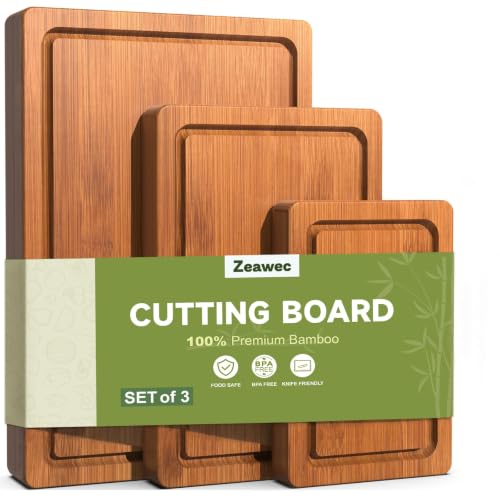
【Say Goodbye To Warped Boards】: Enjoy long-lasting durability with carbonized bamboo that resists cracking and splitting, even with heavy daily use.

PREMIUM BAMBOO CONSTRUCTION – Crafted from dense, carefully selected bamboo, this Cutting Board & Knife Sets offers exceptional strength and durability. The high-density material resists cracking and warping, providing a reliable food prep surface that outlasts ordinary wooden boards.

MULTIPLE SIZES: Kitsure wooden cutting board comes in many sizes. The 15"×10" board is ideal for daily use, the compact 11"×7" board works well for quick jobs like slicing fruits, and the larger 18"×12" board suits for more extensive works like carving roasts. Cutting board sets with various sizes are also available in Kitsure, enabling you to handle different ingredients at the same time.
