Looking for kitchen cutting boards that aren’t wood or plastic? If you want alternatives that are safer, more eco-friendly, or easier to maintain, ceramic, rubber, and composite boards might be your best options.
Each offers unique benefits—ceramic is nonporous, rubber is gentle on blades, and composite is durable and dishwasher safe.
Keep reading to find the perfect fit for your kitchen.
Why Choose a Non-Plastic Cutting Board?
Choosing non-plastic cutting boards helps avoid microplastic contamination in your food. Plastic boards tend to shed tiny fragments during regular use, which can end up in your meals and pose health risks. Non-plastic options like ceramic, wood, bamboo, or metal do not fragment in the same way, making them safer for food preparation. Ceramic pyroceramic boards are especially easy to clean because they are nonporous, resist stains and odors, and don’t harbor bacteria. Wood, bamboo, and metal boards are durable and long-lasting, providing reliable surfaces for daily chopping. Using these materials also reduces your dependence on petroleum-based plastics, lowering your environmental impact. Many of these materials are also well-suited for charcuterie presentation because they offer a stylish, natural look that complements cheese and meats. Proper cleaning remains important, but starting with a surface less likely to trap bacteria or release particles makes your kitchen safer and cleaner. The high cost of premium charcuterie boards often reflects the careful material selection and craftsmanship that ensures both durability and aesthetic appeal. For tasks like carving or heavy chopping, wearing cut resistant gloves can provide an added layer of hand protection against accidental slips.
Knife-Friendly vs. Knife-Dulling Board Materials
Hard surfaces like glass, stone, and ceramic are far too tough for preserving your knives. Their non-yielding nature means they do not compress under the blade, causing the knife edge to absorb impact directly. This results in high friction during cutting, which quickly flattens or causes microchips in your blade. As a consequence, you’ll find yourself needing to sharpen your knives more often. For daily chopping, opt for a cutting board that offers some resilience—materials that gently give way under pressure help maintain your knife’s sharpness. Some bamboo boards, for instance, can be non toxic and moderately knife-friendly, though their hardness still demands more frequent sharpening than wood. Glass boards, though easy to clean and hygienic, often chip and shatter under heavy use or accidental drops. Save ultra-hard surfaces for serving or display purposes rather than for regular use if you want to keep your knives in top shape. Similarly, poor knife storage can also damage blade edges.
Bamboo Boards: Budget Alternative With Faster Knife Wear
Bamboo is a budget-friendly choice for a cutting board, but it does come with some trade-offs. Its dense structure and high silica content make it more abrasive to knife blades than softer woods. Expect your knives to dull approximately 30% faster with regular home use. To compensate, you’ll need to hone your knives weekly and sharpen them every 6 to 12 months. Proper maintenance, including oiling every 4 to 6 weeks, can extend the board’s life to between 5 and 10 years. Compared to wood, bamboo requires board butter vs mineral oil for proper conditioning, though mineral oil is often recommended for its simplicity. Overall, bamboo offers an affordable surface that’s easy to keep clean, but be prepared for more frequent blade maintenance due to faster edge wear. Unlike a charcuterie board, which often features a variety of cured meats and cheeses that may be high in sodium and saturated fat, a bamboo cutting board is a purely functional kitchen tool with no direct nutritional impact. To restore a dull edge on your knives, you can use a serrated knife sharpener to maintain the correct angle and technique.

This set includes three versatile bamboo cutting boards in large (15" x 10"), medium (12" x 8"), and small (9" x 6") sizes. The large board is ideal for carving meats and prepping bulky ingredients, the medium board works perfectly for daily vegetable chopping, and the small board is great for fruits, herbs, snacks, or serving cheese and charcuterie. Having three sizes lets you separate ingredients by type for better kitchen hygiene and efficiency.

THREE IDEAL SIZES FOR EVERY TASK - This bamboo cutting board set includes three essential cutting board sizes - 15x10”, 12x8”, 9x6” - covering all your kitchen needs. Use the small board for quick fruit prep, the medium for slicing vegetables, and the large for carving meats, rolling dough, or creating an elegant charcuterie board spread.

100% BAMBOO: Kikcoin bamboo wooden cutting boards for kitchen preserves the original bamboo grain and texture.The surface is carefully polished and coated with food-grade oil, ensuring a smooth, burr-free finish that resists cracking
Why End-Grain Hardwood Is the Gold Standard for Knife Care
End-grain hardwood boards provide the best protection for your knives and maintain a self-healing surface. When you chop, the vertical wood fibers separate, guiding your blade between them rather than across. This reduces resistance, resulting in less abrasion and prolonging the sharpness of your knives. The fibers then spring back after each cut, closing minor marks and keeping the surface smooth over time. Similarly, the notch on a butter knife is designed to separate the fibers of bread, preventing the blade from sticking to the soft crumb. For serrated knives specifically, using a ceramic sharpening rod between the scallops can restore the edge without damaging the blade.
Premium hardwoods like maple or walnut are typically used, often shaped with specific texturization techniques that improve their shock-absorbing qualities. This design not only enhances feel but also promotes material sustainability. Well-maintained end-grain boards can last for years, resisting deep wear better than softer options. Regular mineral oil application prevents drying out, and hand washing keeps the surface stable. Though they tend to be heavier and more expensive, their superior knife care and quieter cutting experience make them a top choice. Unlike some gloves that rely on layered cut-resistant materials for safety, an end-grain board’s structure is inherently designed to protect your blades from harm.

Experience the beauty of premium solid walnut! Crafted from premium natural walnut wood, this walnut wood cutting board is finished with natural oil to boost durability and create a smooth surface, preserving the wood’s pure natural qualities for daily kitchen use. It serves as an ideal food prep surface, and this family-friendly wooden cutting board lets you cook with joy in your kitchen while caring for your family’s well-being.
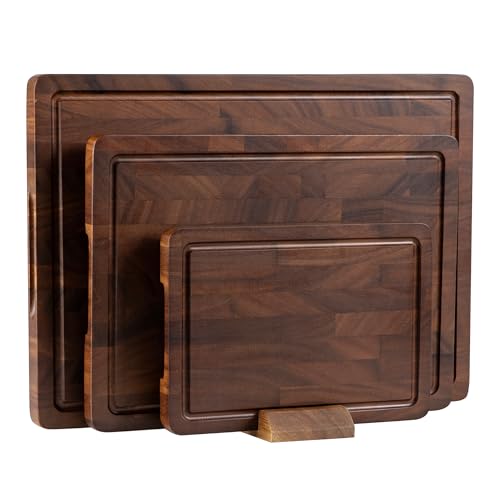
【Craftsmanship and Material】THETCHRY cutting board set is meticulously crafted from genuine South American Walnut. Renowned for its dense grain, walnut is considered the premier material for high-end kitchen tools. Not only is this board 1.5 times harder than ordinary wood, but its end-grain pattern effectively minimizes knife marks, protecting your blades with every cut.

Still looking for a cutting board that is both beautiful and practical? THETCHRY end grain walnut cutting board is the ideal choice for you! The unique structure has excellent durability and can withstand heavy cutting without being easily damaged. Its "self-healing" property makes every cut as smooth as silk. The blade cuts between the wood fibers and the fibers quickly close after leaving, keeping the knife sharp as new.
Rubber Boards: Quiet, Stable, and Gentle on Edges
Rubber boards are gentle on your blades because rubber is softer than wood or glass, which helps reduce edge wear and keeps your knives sharper for longer. The non-porous surface resists moisture and odors, maintaining a hygienic workspace. While wood boards can harbor bacteria in deep knife scores, rubber’s non-porous nature makes it a more sanitary option for raw meat preparation. To keep them clean, hand washing is recommended—simply wash, rinse, and dry. Designed for heavy daily use, rubber boards resist warping and stay flat over time, providing a durable and quiet surface that’s easy on both your knives and your ears. Unlike some materials, rubber boards offer better durability and require less upkeep than many wood or plastic options. For those interested in crafting a similar long-lasting workspace, the step-by-step process for butcher blocks emphasizes using straight-grained hardwoods to prevent warping and cracking over time.


Versatile 2-piece set: Includes one 7.25 x 10.75 inch Prep Board and one 9 x 12.9 inch Everyday Cutting Board, perfect for slicing, dicing and daily kitchen prep

Silicone Boards: Flexible and Dishwasher-Safe for Light Prep
Silicone boards are ideal for light prep tasks because they are flexible and dishwasher safe. You can easily bend them to funnel chopped herbs or fruit directly into a pan, preventing messes. Their non-porous surface resists odors and moisture, which helps keep them hygienic and prevents residue absorption. Made from food-grade silicone that is BPA-free and certified for contact, many are also eco-friendly. These boards can withstand high heat in the dishwasher without warping, making cleanup quick and effortless. However, they are best suited for gentle tasks such as slicing soft produce. Over time, deep grooves may develop from frequent use, so replacing them when wear appears helps maintain food safety. Their lightweight design makes them easy to store in tight spaces. The thick silicone construction ensures resistance to cuts even with sharp knives. For those who also use premium blades, these boards protect the edge better than harder materials, making them a good match for Japanese knives. For tasks requiring a harder surface, some users prefer a top-rated utility knife for scoring materials without dulling the blade. Unlike standard plastic boards that can warp or stain in the wash, silicone boards are non-porous and heat-resistant, ensuring they remain hygienic after repeated dishwasher cycles.
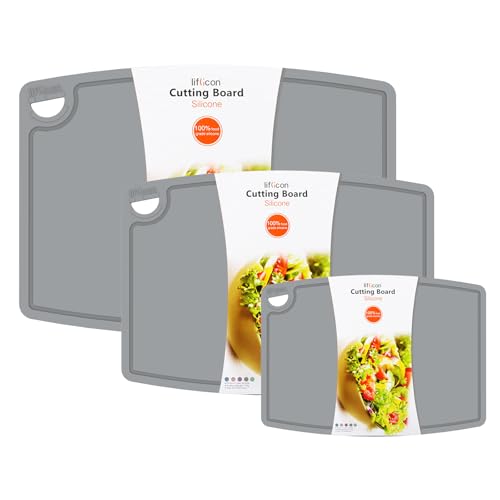
【SIZE AND COLOUR】: Extra Large: 370*250*5mm(14.6'' x 10.43'' x 0.2") Weight:550g ;Middle Size: 320*230*5mm(12.6'' x 9.1”x 0.2"), Weight:400g; Mini: 230*180*4mm( 9.1”x7.1”x0.16“)”, Weight:190g. set of 5 modern colour coded high thick silicone cutting boards.

Innovative Fold-lock Design: you will get 2 pcs 14.3 x 9.8 inches/ 36.5 x 25 cm blue and green large thick silicone cutting boards, features a built-in tongue and groove system that locks the board in an upright position when folded; Its slim, Lightweight and portable, stackable profile is suitable for drawer storage or hanging

INCLUDES Three premium silicone cutting boards in 3 versatile sizes for every task. One large cutting board roomy enough for carving meats, one medium ideal for daily veggie prep, and one small cutting board perfect for bar garnishes and snacks
Glass, Stone, and Steel: Best Hygiene, Worst for Blade Life
Glass, stone, and stainless steel are the materials that offer the best hygiene for cutting surfaces, but they also lead to the worst blade wear. Since their non-porous surfaces prevent bacteria from soaking in, they are easy to clean thoroughly—scrubbing away raw meat residue is straightforward. However, this benefit comes with a drawback: each material accelerates the dulling and chipping of your knives over time. While wood boards benefit from top cutting board waxes to protect the surface and maintain performance, these hard materials cannot be treated similarly. Glass is the most aggressive on blades. It dulls edges quickly and increases the risk of micro-chipping due to its hardness. Stone surfaces like marble or granite also wear down blades faster because of their abrasive, hard textures. Stainless steel boards, while excellent for sanitation, have no give or soft surface to cushion blades, which leads to faster wear than softer materials like wood or plastic. Unlike wood, which some studies suggest has natural antibacterial properties that can reduce surface bacteria even without chemical cleaners, these hard materials rely entirely on their non-porous structure for hygiene.
These surfaces allow fast, sanitary cleaning but demand more frequent sharpening. They prioritize hygiene but compromise blade longevity, making them less ideal for daily use if maintaining sharp knives is a priority.
Composite Boards: Durable, Low-Maintenance Middle Ground
Composite boards like Richlite provide a durable, low-maintenance option that balances the qualities of wood and plastic. They feature a dense, non-porous surface that resists warping, cracking, and staining, eliminating the need for oiling or special treatments. Cleaning is simple—just wash with soap and water or place in the dishwasher. Made from eco-friendly materials such as compressed paper fibers and resin, these boards are a sustainable choice. Their aesthetic appeals often match natural wood, so you don’t have to compromise looks for functionality. With heat resistance up to 350°F and excellent moisture tolerance, they prevent odor absorption and handle raw ingredients effectively. Although tougher on blades than soft wood, they are still gentler over time than plastic, making them a practical option for daily chopping without fuss.

Natural wood fiber based cutting surface trees are harvested from managed forests. Made in the USA
DURABLE: Epicurean's paper composite material is a natural material. Color, primarily our natural color, will develop a deep patina over time, behaving similar to wood or a wood floor. Patina does not affect the performance or integrity of the product/material and Epicurean does not guarantee color fastness for the life of the product. PROUDLY MADE IN THE USA.

DURABLE: Epicurean's paper composite material is a natural material. Color, primarily our natural color, will develop a deep patina over time, behaving similar to wood or a wood floor. Patina does not affect the performance or integrity of the product/material and Epicurean does not guarantee color fastness for the life of the product. PROUDLY MADE IN THE USA.
Match Your Non-Plastic Cutting Board to Your Cooking Style
Matching your non-plastic cutting board to your cooking style means prioritizing function over appearance. For serving-focused setups, glass or ceramic boards are ideal because they’re easy to clean and look good on your counter. However, they can damage your knives, so keep that in mind. Baking-heavy kitchens benefit from stone or marble surfaces—they stay cool and provide a stable work area for dough—but avoid chopping directly on them to prevent surface damage. If you cook daily with lighter prep tasks, bamboo offers a great balance: it’s eco-friendly, reasonably durable, and easier to maintain than hardwood. Just remember to oil it regularly to preserve its quality. Ultimately, choose a board based on how you prep food and what best suits your knife maintenance needs—not just for visual appeal.
Best Non-Plastic Board Setup for Raw Proteins vs. Vegetables
A two-board setup is essential for preparing raw proteins and vegetables with nonplastic boards. Use one nonporous board, such as stainless steel or synthetic rubber, for raw meat, poultry, and seafood. These materials are easy to clean and sanitize, reducing cross-contamination risks. For your vegetable board, choose a tight-grain hardwood like maple or walnut. Hardwood boards are knife-friendly, durable, and bring an organic, sustainable feel to your kitchen. The natural grain and vintage aesthetic of these woods make them ideal for vegetables and bread. Clean your raw-protein board immediately after use with hot, soapy water and sanitize it to prevent bacterial transfer. Wash your vegetable board after each use, but skip heavy sanitizing unless contamination has occurred. This split between nonporous and wooden boards ensures safety without sacrificing performance or aesthetics.