Wondering what angle to sharpen your kitchen knives at? Choosing the right edge angle can make all the difference in how well your knives cut and how long they stay sharp.
For everyday use, a 20° angle per side is usually best, offering a good balance of sharpness and durability.
Want precision cuts or a super sharp edge? Keep reading to learn how to match your knife’s factory angle and get the most out of it.
What’s the Best Sharpening Angle for Your Kitchen Knife?
The ideal sharpening angle for your kitchen knife generally falls between 17° and 20° per side. For most home cooks, maintaining this range offers a good balance between sharpness and durability. A 20° angle provides strength, making it suitable for everyday tasks like chopping and slicing. If you prefer a finer edge for precise cutting, angles closer to 15°—common with Japanese-style blades—offer sharper, more delicate edges. However, these are less durable and may require more frequent touch-ups. Similar to how a quality charcuterie board balances strength and style, selecting the right angle ensures your knife performs well without sacrificing longevity. Japanese blades often feature a harder steel that allows for a more acute angle, typically around 15°, to maximize cutting performance.
Your knife’s original bevel and material are key considerations. Reprofiling beyond the factory angle can waste steel and weaken the edge. Softer steels benefit from a sturdier angle, around 20°, to resist chipping. Harder steels can handle a more refined edge, around 15°–17°, without sacrificing durability. Always match the angle to the knife’s design and how you plan to use it; insistence on the sharpest possible edge can lead to premature dulling or damage. The specific degree range for each blade style, from santoku to gyuto, should guide your sharpening setup to prevent edge failure. Remember that for serrated knives, specialized tools are often required to reach the serrations effectively, such as those reviewed in Best Sharpeners for Serrated Knives.
20° Per Side: The Durable Default for Most Home Cooks
Edge geometry set at 20° per side results in a 40° inclusive angle, which strikes a good balance for most home cooks. This angle makes your knife forgiving when cutting through dense foods or when making frequent contact with the cutting board. Unlike blades with lower angles that require constant touch-ups and sharpening, a 20° bevel maintains its sharpness longer and is less fragile. Japanese knife sets often feature harder steel alloys that benefit from this durable angle to prevent chipping during heavy use. To keep an even and consistent edge, use a sharpening guide to match your existing bevel before making any adjustments. You should also avoid putting wood cutting boards in the dishwasher because the heat and moisture can warp and crack the wood, shortening its lifespan. For ceramic knives, however, special diamond abrasives are essential to effectively grind and polish the hard blade material. This ensures your blade remains safe and effective for a variety of kitchen tasks.

It makes sharpening blade edge like a pro!

【Fixed 20° Angle Guide】 This angle guided knife sharpener adopts factory preset 20° guide to simplify sharpening work. As a handheld angle sharpener, this angle guided sharpener stays locked at ideal 20° geometry without extra calibration. Consistent sharpening angle delivers precise edge every time with no learning curve.
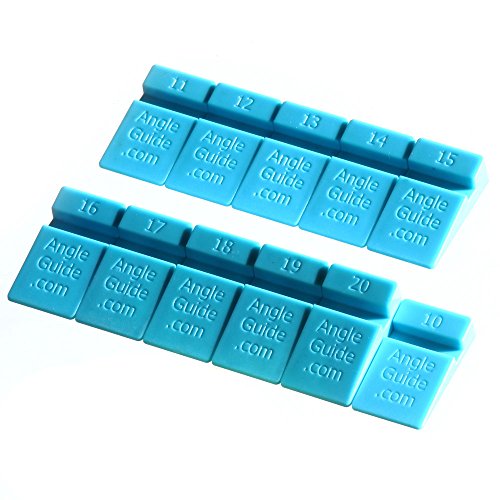
Model: Wedgek AGM Medium size. For larger size model Wedgek LR5 is available.
What Angle Should Beginners Start With?
For beginners, starting with a 20° angle per side is ideal. This angle provides a good balance between sharpness and durability, making it easier to maintain consistently. It is a forgiving and practical default that suits most kitchen tasks. Matching the factory angle when possible helps preserve the knife’s original geometry and prevents over-thinning the edge. Additionally, after stropping, using a high-quality stropping compound can refine the edge for even better performance.
Use the 17°–20° range as a helpful guide; it is common among home cooks learning to control their sharpening angles. Avoid very low angles initially because they are harder to sustain and the edges tend to chip more easily. To ensure proper angle control, utilize angle guides or mark the blade with a marker to verify your strokes frequently. Beginners should understand that the original factory angle is designed for balance and is safest to follow. Following this approach also helps you recognize signs that say it is time to sharpen before the edge becomes too dull.
A typical mistake for beginners is trying to sharpen at very steep angles prematurely, which can lead to uneven edge distribution and damage. Sticking with the 20° default allows you to develop consistency and confidence without risking early damage. This angle creates a durable edge capable of handling mixed kitchen tasks, giving you room to focus on technique and gradually improve. Using a durable epoxy surface for your sharpening setup can help stabilize the knife and prevent accidental slips during practice.
Why 15° Per Side Works Best for Japanese Knives
A 15° angle per side is optimal for Japanese knives because their steel is typically hardened to around 60–65 HRC. This sharper edge angle allows you to maximize the hardness’s benefits, creating a finer, more acute cutting edge that excels at slicing through fish and vegetables. Regular use of quality Japanese sharpening stones is essential to maintain this precise edge geometry. The reduced angle minimizes drag and wedging, resulting in cleaner, smoother cuts without compromising the knife’s durability for everyday use. If you are assembling a kitchen knife set, consider pairing your Japanese knives with a robust chef’s knife and a paring knife, as these are essential tools that cover most prep tasks while allowing you to skip less versatile specialty blades. To ensure your knives stay in top condition, look for a set that includes a sharpening steel for regular maintenance.
When sharpening your Japanese knife, maintaining a 15° per side angle strikes the right balance. It’s sharp enough for precise push cuts and delicate work, while still sturdy enough to resist chipping during routine kitchen tasks. Going more acute than 15° can make the edge too fragile for regular use, increasing the risk of damage. Adopting this standard angle helps your hard steel perform at its best, providing lasting sharpness with less frequent maintenance—making it the practical choice for double-bevel Japanese knives.

【Complete Knife Sharpening Stone Kit】You don't need to be a Pro to sharpen your blades, all you need is the right tools & technique. All the sharpening tools you need are here, one affordable set for you: 400/1000 & 3000/8000 grit whetstone; Coarse flattening stone; Non-Slip Bamboo base; Knife sharpening angle guide; Leather strop, a simple instruction manual about how to use and what does every component do.
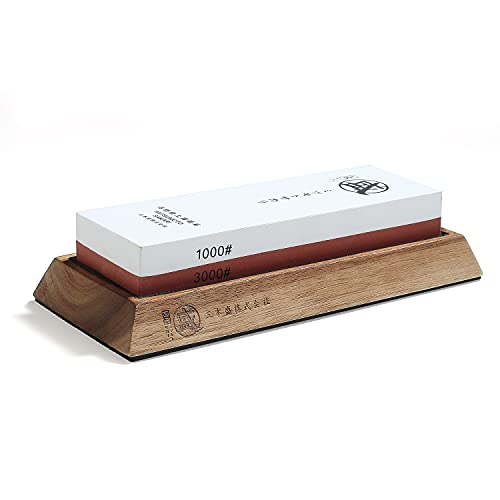
1000/3000 Grit Dual-Sided Whetstone: 1000 grit side quickly repairs dull edges and reshapes worn blades for daily meal prep; 3000 grit side hones and polishes edges to a smooth, razor-sharp finish for clean cuts of meat, fish, vegetables and fruit.

Premium Quality Sharpening Stone Materials: Quality White Corundum, 400/1000 and 3000/8000 knife sharpening stones suitable for most grinding operations, 4 types of grit work well with expensive or budget-friendly stainless steel kitchen knives
How Different Angles Change Sharpness and Durability
The angle of a knife edge directly influences its sharpness and durability. Lower angles, around 15°, produce thinner, sharper edges that cut with less resistance, ideal for delicate tasks such as slicing tomatoes or fish. However, these fine edges are more prone to rolling or chipping under heavy use, leading to a shorter edge lifespan. Higher angles, between 20° and 25°, add more steel behind the bevel, which strengthens the edge and extends its usability. These angles resist deformation better, requiring less frequent sharpening, but they may require more force when cutting through dense or hard foods. For serrated knives, a similar principle applies, though the correct technique involves maintaining the original factory bevel on each scalloped tooth rather than altering the angle. Choosing the right angle depends on your regular tasks. For fine, precise cuts, a lower angle delivers excellent sharpness but at the cost of durability. For heavy-duty work like chopping bones or hard squash, a higher angle ensures the edge withstands tougher conditions. Remember, lower angles sharpen your cutting edge but dull faster, whereas higher angles prioritize durability over the utmost sharpness. Your daily cutting needs should guide your decision between these options. Using a clean, long-lasting cutting board surface can help protect the edge from unnecessary wear during use. While oil-based care is often recommended for maintaining wooden cutting boards, choosing the right cutting board oil can also help preserve the knife edge by reducing friction during use.

15° Whetstone Angle Guide: Helps keep a steady sharpening angle on a whetstone, so beginners can build a more repeatable stroke for kitchen knives and chef knives.

CONSISTENT FIXED ANGLE — Attaches securely to your blade to maintain a steady, repeatable angle against the whetstone, helping you avoid the uneven edges that come from freehand sharpening.

𝐀𝐜𝐡𝐢𝐞𝐯𝐞 𝐫𝐚𝐳𝐨𝐫-𝐬𝐡𝐚𝐫𝐩 𝐞𝐝𝐠𝐞𝐬 𝐞𝐯𝐞𝐫𝐲 𝐭𝐢𝐦𝐞: SHARPAL 194H is the perfect tool to ensure that your knives, chisels and Plane Iron Blades are always sharpened at the correct angle, resulting in sharper edges that last longer.
How to Find Your Knife’s Factory Sharpening Angle
To find your knife’s factory sharpening angle, start by checking the original packaging, manual, or manufacturer website, as they often list the specific angle for your model. CRKT, for example, confirms each knife is set with a factory edge angle suited for its intended use. For a comprehensive comparison of top cutlery sets, you can review guides that assess quality, performance, and value. If this information isn’t available, examine the existing bevel under bright light. A narrow bevel suggests a smaller angle, typically around 15°, while a wider bevel indicates a steeper angle closer to 20° or more. For a broader perspective, white knife sets with blocks are often evaluated for how their factory angles balance quality and durability. Different graters, however, prioritize rotary cheese graters for efficient, consistent shredding rather than edge sharpness.
Knowing this baseline helps your maintenance routine by ensuring you don’t inadvertently change the factory edge unnecessarily. Use tools like a guided angle checker or a laser goniometer for a precise measurement. For kitchen knives, Western or German-style blades usually have a sharpening angle of about 20° per side, while Japanese knives often sit around 15–17°. When sharpening, adjust your angle in 1–2° increments, stopping when the stone sits flush against the bevel, which ensures you’re maintaining the original factory geometry without causing unnecessary removal of material.

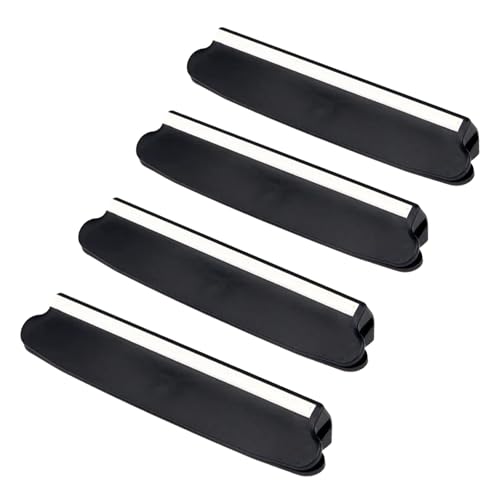
【Package content】:4 Black knife sharpener angle guides, Angle of about 15 degrees, The length is 3.3 inches/100mm, The width is 0.78 inches/20mm

PRECISION ANGLES EVERY TIME Lock in your desired bevel (up to 30°) with the micro-adjustable clamp. Note: This kit does not include an angle gauge. For the digital angle finder combo, order ASIN:B0F8V6ZCND.
Use the Marker Method to Match Your Angle
The marker method is an effective way to match your knife’s sharpening angle precisely without guesswork. First, clean and dry the bevel thoroughly. Then, apply a thin, even layer of black permanent marker across the entire bevel near the edge on both sides, ensuring the markings are symmetrical. Take a few light strokes with your sharpening stone—avoid pressing too hard, as heavy strokes can remove too much metal before you can assess the marks. This method helps you avoid the pitfalls of unhealthy eating habits by ensuring your knives are sharp and safe to use, reducing the risk of slipping and injury. Check the pattern of the ink removal after sharpening. If the ink has vanished only from the edge but remains higher up the bevel, your angle is set too high. If it’s gone only from the upper part of the bevel, your angle is too low. When the ink is evenly wiped away across the entire bevel, you’ve achieved the correct sharpening angle. The Tormek T1 Mora knife sharpener is designed to combine precision and ease for such tasks. Adjust your strokes in small increments and reapply the marker if needed. Repeat the process until the ink is consistently removed from the heel to the tip of the blade, indicating you’ve matched your desired angle. A well-maintained silverware set with steak knives can further enhance your dining experience by pairing quality cutlery with properly sharpened blades. Finish by alternating edge-leading strokes to develop a sharp, balanced edge.

WHETSTONE KNIFE SHARPENER — NO SKILL, NO GUESSWORK Most people avoid whetstones because holding the correct angle is intimidating. The included angle guide locks your blade position automatically — making professional knife sharpening practically idiot-proof, even on your first try. No oil needed, no mess, no guesswork.

2 dual-sided whetstones: 400/1000 grit and 3000/8000 grit for ultimate control; stones use water (vs. oil) for sharpening; clean easily with water

【G-Clamp with Maximum Tightness】 With a G-Clamp tightly clamping on the table, stool, kitchen stove or other platforms, this RX-008 Metal Fixed-angle Edge Sharpener can be tightly clamped, and a metal blade fixture holding the blade firmly and safely. Most of the material of this sharpener is stainless steel, highly durable & long lasting.
When to Use a Higher Sharpening Angle (22°+)
A sharpening angle of 22° or more is ideal when you need a more durable edge that can handle heavy-duty use. This higher angle resists deformation and rolling under pressure, making it suitable for tough ingredients like dense vegetables or meats. Knives with a Western-style chef’s design often benefit from this angle, especially when paired with a sturdy, ergonomic handle that provides a firm grip during repetitive chopping tasks. The increased angle also offers better protection against incidental contact in block storage solutions, helping the edge stay intact longer.
While you may sacrifice some of the precision and finesse that a sharper, lower-angle edge offers, the trade-off is a longer-lasting edge that requires fewer touch-ups. If your work involves aggressive cutting, heavy chopping, or use in demanding environments, a higher sharpening angle around 22° or above enhances the knife’s stability and longevity. Overall, this angle is best when edge durability outweighs the need for razor-thin sharpness.