Figuring out which kitchen knives you really need can feel overwhelming. Fortunately, just three essential blades will cover most tasks: an 8-inch chef’s knife, a small paring knife for delicate work, and a serrated bread knife.
By sticking with these basics and choosing quality stainless steel around $40 to $80, you can build your skills without clutter.
Keep reading to see how each blade fits your cooking style and why these are the right starting points.
Why Your Starter Knife Set Needs Only 3 Knives
A starter knife set needs only three knives because these cover all essential cutting tasks without excess. The paring knife handles small, precise jobs like peeling, trimming, or deveining. The utility knife fills the middle ground for slicing fruits, vegetables, and leftover cooked meats. The third knife should be either a chef’s knife for larger chopping or a bread knife for crusty loaves and soft insides. This trio offers clear distinctions between each role, avoiding unnecessary overlaps. Many enthusiasts seek Top Damascus Knives for their superior edge retention and aesthetic patterns, but a basic starter set prioritizes function over ornament. When comparing different sets, it helps to read a Guide to the Best Cutlery Sets to understand which brands offer the best balance of quality and value.
Having just three knives simplifies storage, making it easier to organize and access your tools quickly. It also reduces the clutter in your drawer or knife block, helping you stay efficient in the kitchen. Fewer knives mean less time spent on maintenance—sharpening, washing, or replacing—saving you both effort and money. This streamlined setup is practical for beginners, so you can master basic techniques without distraction or confusion. The Wüsthof Classic 3-Piece Starter Knife Set, made in Solingen, Germany, is an example of such a high-quality trio. When choosing a starter set, buyers often compare quality, performance, and value across top brands to ensure their investment lasts for years.
What a Chef’s Knife Can (and Can’t) Do for You
A chef’s knife can handle around 80% of your daily prep tasks. Its versatile, curved blade allows you to rock-chop herbs, dice onions, and slice boneless proteins efficiently. The curved edge facilitates a natural rocking motion, making repetitive cuts quicker and less tiring. However, it’s not suited for every task. For bread, fish fillets, or hard bones, you’ll need different knives or techniques. The blade isn’t designed for fine precision work or butchery involving hard bones. Regular maintenance is key to keeping your knife sharp and safe. Hone it frequently with a sharpening steel, and wash it by hand to avoid corrosion. While a chef’s knife is essential for most preparations, understanding its limits ensures you use it effectively and safely. Affordable Japanese knives are a great option for building a high-quality starter set without exceeding your budget. To prolong your knife’s edge and prevent warping, seasoning wooden handles with food-safe oil is a crucial upkeep step. Always select a food-safe oil that is specifically formulated for wooden kitchen tools to ensure it won’t turn rancid or impart unwanted flavors to your food.
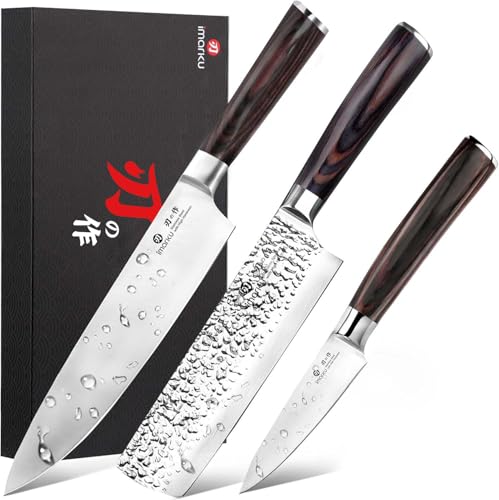
Ultra Sharp Professional Edge:Each knife in the imarku kitchen knife set is carefully hand-polished by skilled craftsmen with a 15° double bevel edge and 2.3mm blade thickness for exceptional cutting precision. These ultra sharp kitchen knives glide effortlessly through vegetables, fruits, fish, and meat, delivering a smooth and professional cooking experience

【Damascus Knife Set】Atumuryou 3 piece knife set comes with 8" Chef Knife, 7" Santoku Knife and 3.5" Paring Knife, effortlessly handling everything from meat cutting and vegetable chopping to fruit preparation. Whether for home cooking or professional use, this is an ideal choice.

Portable & Travel-Friendly: This chef knife set with roll bag offers safe, easy transport. Each knife has its own slot and guard, keeping blades protected—perfect for camping, BBQs, travel, or culinary training.
The Paring Knife: Best for Small, Precise Cuts
A paring knife is typically 3 to 4 inches long, making it ideal for small, precise cuts. Its compact size allows you to work comfortably in tight spaces without the bulk of larger blades. You’ll find it especially useful for mincing garlic, segmenting citrus, or trimming vegetables with finesse. To maintain a perfect edge, consider investing in Japanese sharpening stones for regular honing and sharpening. For ceramic knives, it is critical to use diamond abrasive stones specifically designed for their hardness. When choosing one, look for high-carbon stainless steel for sharpness and durability, and remember to hand wash and dry it immediately to preserve its fine edge. Unlike hard surfaces such as glass cutting boards, which can dull blades quickly, a quality pairing knife paired with a proper cutting board will maintain its edge far longer.

Tramontina Colorado 3-inch Chef's Paring Knife features

High-quality stainless steel blades

Superior high-carbon stainless steel blades for precision and accuracy
Why a Serrated Bread Knife Belongs in Every Kitchen
A serrated bread knife is essential because it excels at slicing through tough crusts without crushing the soft interior. Its serrated edges grip crusts immediately, requiring less pressure and avoiding squishing the bread. This makes it ideal for cutting artisan loaves, baguettes, and sandwich rolls, helping you achieve clean, even slices every time. This same principle of clean slicing is vital when assembling charcuterie boards, where preserving the texture of crusty breads and delicate accompaniments enhances the overall presentation. Pairing these slices with a stylish book-shaped cutting board can elevate the visual appeal of your presentation. Beyond bread, its versatility shines. Use it for tomatoes, where the serrations easily penetrate the skin without dragging or tearing. It also works well for cakes, giving you clean cuts with minimal damage to delicate layers. The low-friction serrations give you more control over slippery foods, enhancing safety. A longer blade helps cut wide loaves smoothly, and offset handles provide knuckle clearance, making slicing more comfortable. Thanks to the durability of serrated blades, your knife stays sharp longer before needing professional sharpening. For those seeking a well-rounded collection, a high-performance santoku can serve as a versatile alternative to a chef’s knife for chopping and slicing. With this one tool, you can handle a variety of tasks, making your kitchen more versatile and efficient.

Premium Quality Blade: This bread cutting knife is crafted from high carbon stainless steel (0.26%-0.35% carbon, 12%-14% chromium), the best bread knife’s blade is oil-tempered and heat-treated to HRC 53±1 for optimal sharpness and durability. Precise 2.3mm thickness ensures a perfect balance between sharpness and toughness

CLEAN SLICES FOR CRUSTY LOAVES – The long 10-inch serrated blade grips sourdough and artisan crusts while cutting through soft interiors with less crushing.

Ultimate 10-Inch Professional Blade: The ideal 10 inch bread knife for serious bakers. Its extended length allows for single-motion slicing through large sourdough bread boules and artisan bread without the need for repetitive sawing, ensuring a clean, bakery-quality finish every time
Best Blade Sizes for a Starter Knife Set
Blade size is crucial because it directly affects your control and comfort during use. An 8-inch chef’s knife is ideal for a starter set because it offers a balance between reach and precision, making it versatile for chopping, slicing, and mincing. If an 8-inch feels too large, a 6–7 inch option provides better control and improves knife ergonomics, especially if you have smaller hands. Using a ceramic rod for regular honing will help maintain the blade’s edge between sharpenings. For optimal edge retention, many top Japanese knives use high-carbon steel that holds a sharp edge longer than standard stainless. When selecting a knife, it is also helpful to consider professional kitchen knives that are reviewed for quality and performance to ensure your starter set meets high standards.
Include a 3–4 inch paring knife for detailed tasks like peeling and trimming. Its short blade allows for precise control when working with small, delicate items. Add a 5–6 inch utility knife to handle tasks such as sandwich prep, slicing fruit, or working with small proteins, filling the gap between your paring and chef’s knives. By selecting these sizes, you cover nearly every daily kitchen task without overwhelming your knife block. The knives feature curved bolsters that encourage a safe and precise pinch grip for better control.
Chef’s Knife vs. Santoku: Which Should You Buy First?
A chef’s knife is generally the better choice for your first quality knife because of its versatility and larger size. With an 8-to-10-inch curved blade, it’s designed to handle a wide range of tasks such as slicing, dicing, and mincing across various ingredients. Its heavier weight helps with powerful cuts and chopping motions, making it suitable for larger or tougher foods. For those considering a lighter alternative, high-rated utility knives offer excellent precision for everyday slicing tasks. While some premium knives boast decorative patterns, understanding authentic Damascus steel helps avoid overpaying for mere aesthetics. Similarly, the high cost of some kitchen tools can be driven by artisan craftsmanship rather than functional performance.
A santoku, on the other hand, features a shorter, lighter blade measuring about 5 to 7 inches. Its flat edge excels at push-cut techniques, offering excellent control for slicing vegetables, fish, or boneless meats. It’s ideal if you prefer precise, straight cuts or work primarily on lighter prep.
Choosing between the two depends on your typical prep style. Opt for a chef’s knife if you want a versatile tool capable of handling a broad range of tasks and manageable for heavy-duty chopping. Pick a santoku if you value fine control for lighter, delicate cuts and enjoy a more nimble, compact option. Both knives benefit from regular sharpening, but your comfort with different cutting techniques should guide your decision.

High-Carbon Stainless Steel Blade: It is manufactured from high-quality stainless steel that maintains its functionality for a long time. And to boost its sturdiness, the steel contains 0.6-0.75 carbon. This makes it two times as hard as other knives in its class as they contain about 0.3% carbon

【High-End Japanese Steel Chef's Knife】 HOSHANHO chef's knife is made of Japanese high carbon steel 10Cr15CoMoV, 2x of the sharpness and durability of some other “premium” knives, and it owns a very high cost performance! With a hardness of up to 60 HRC, the kitchen knife offers excellent rust resistance, sharpness and durability.

【Premium Material Chef Knife】Crafted from high-end 1.4116 high carbon stainless steel with 58±2 HRC hardness, this professional chef’s knife delivers lasting sharpness and edge retention. The rust-resistant blade combines modern technology with traditional forging. Whether you're prepping a week of family meals, breaking down whole chickens, or slicing through butternut squash and pineapple, this knife stays sharp and reliable – no more stopping to sharpen mid-task.
Starter Knife Mistakes: What to Skip
Avoid oversized blades and specialty knives when building your first knife kit. Stick to a basic chef’s or santoku knife, which are versatile and easier to handle. Full block sets usually include duplicates you’ll rarely use, so opt for individual purchases. This approach gives you better control over quality and ensures each knife fits your needs.
Dull knives are a safety hazard. They require more force to cut, increasing the chance of slips and injuries. Make knife sharpening a regular habit from the start, instead of waiting until blades are noticeably dull. For on-the-go maintenance, consider keeping one of the best pocket sharpening stones in your kit for quick touch-ups. Also, steer clear of glass cutting boards and loose drawer storage, both of which can dull edges quickly and pose safety risks. Never put your knives in the dishwasher—hand wash and dry immediately to keep them in top shape. And avoid using your knives as pry bars or screwdrivers, which damages blades and compromises safety. For safe, organized storage, consider using steak knife storage boxes to protect your blades from damage and keep your drawer clutter-free. Focusing on just a few core knives and maintaining them properly helps you prep efficiently and safely. Additionally, be cautious when choosing high-carbon steel blades, as some are prone to rust if not dried immediately after washing.
Should You Add Shears and a Honing Steel From the Start?
Adding shears and a honing steel from the start is advisable if your budget and kitchen organization allow. Most starter knife sets include both because they are considered essential tools. Shears are highly practical for tasks like trimming herbs, snipping packaging, or portioning poultry, and they help preserve your chef’s knife by avoiding unnecessary wear. You’ll find yourself reaching for them more often than expected.
A honing steel supports your knives’ maintenance by realigning the edge rather than sharpening. Regular use prolongs the time between actual sharpenings. Use the steel lightly at a 20-degree angle every few uses, but practice proper technique to avoid damaging the edge. Poor handling can cause more harm than good.
Including both shears and a honing steel adds some bulk and cost, but dedicated block slots make storage simple. Prioritize your three core knives first, but if your budget and space allow, adding shears and a 9-inch honing steel from the beginning gives you immediate practicality and helps maintain your blades efficiently.
How to Choose Your First Quality Starter Chef’s Knife
Choose an 8-inch blade for your first quality starter chef’s knife. This size offers the best balance of reach and control, making it versatile for various daily tasks. It’s large enough to handle bigger ingredients yet still manageable for beginners, unlike a 6-inch that may feel limited or a 10-inch that can be unwieldy.
Prioritize high-carbon stainless steel—preferably German or Japanese—for its ability to maintain a sharp edge without being fragile. The weight should be around 6 to 9 ounces; a well-balanced knife reduces fatigue during extended prep sessions, helping you work comfortably.
Select a textured synthetic handle, like Fibrox, for slip resistance. This feature helps prevent accidents and reduces the need for a death grip, especially when your hands are wet or greasy.
Set a budget of $40 to $80 for your first high-quality, everyday knife. Proper storage is essential for safety and maintaining the edge: consider a magnetic strip or blade guards. This single versatile knife can handle most kitchen tasks, eliminating the need for a full block set.

Professional Chef's Knife: This PAUDIN kitchen knife is suitable for cutting bread, vegetables, fillets or meats etc, and is also suitable for home and professional use. Cutting like a master chef will bring you more joy in the kitchen

PROFESSIONAL ALL-ROUND CHEF'S KNIFE: Bolexino 8" chef's knife with WIDE blade for commercial use and home cooking available. Containing all the essentials for you to chop, slice and dice to easily handle a variety of kitchen tasks. It's well balanced and simply beautiful to behold. Bolexino knife is the good choice for your kitchen.

QUALITY CONSTRUCTION: Knife is precision-forged with high-carbon German steel for better durability, and taper-ground edge allows for increased efficiency when cutting along with incredible long-lasting sharpness